
Why Your Remote Only Works at the End of the Driveway — A Practical RF Interference Troubleshooting Guide
Updated: February 11, 2026 — Desert Door Network
Your remote works only at the end of the driveway because a local RF noise source near the garage raises the receiver’s noise floor and desensitizes the opener’s radio. Cheap LED drivers, switching power supplies, yard lights, or nearby wireless gear commonly create that noise. Fixes start with quick isolation tests (swap bulbs, shut circuits off), then apply ferrite chokes, filters, or replace the offending hardware. arrl.org
Quick answer
A nearby emitter (often an LED driver, dimmer, or switching power supply) can overwhelm the opener’s receiver front end so the garage only responds when you are far enough away that the remote’s signal avoids the worst coupling. Start with quick bulb and breaker checks, then try ferrite chokes, filters, antenna relocation, or replacing the offending device.
Symptom map — what “only works at the end of the driveway” usually means
- Remote works reliably several dozen feet away but fails when you are near the garage.
- Wall switch still opens the door; only wireless control is unreliable.
- Problem began or worsened after adding LED fixtures, holiday lights, security cameras, or a new appliance.
- Intermittent operation correlated with lights being on, certain times of day, or when an HVAC/pool pump cycles.
How RF interference near the garage breaks remotes
Claim: A local noise source close to the opener can block or confuse the opener’s receiver.
Evidence: Receivers have limited dynamic range; a nearby emitter can swamp the front end and reduce sensitivity, a phenomenon called desensitization or “blocking.” ARRL documentation and field investigations show lighting and power equipment as common culprits. arrl.org
Implication: The receiver fails to distinguish a valid remote burst from background noise. This often makes the system work only when you are far enough away that your remote’s signal arrives by a different path or the noise coupling is weaker.
Receiver desensitization / front-end overload
The garage opener is listening for a tiny burst of RF from your remote. If local electrical equipment emits continuous or wideband bursts on nearby frequencies, the opener’s receiver can be overwhelmed. Overload is not the same as “too little remote power” — batteries can be fine while the receiver’s front end is jammed. arrl.org
Common domestic RF sources
- LED drivers, LED dimmers, and cheap holiday light controllers (switch‑mode supplies and PWM dimming create harmonics). alibaba.com
- Security cameras, wireless transmitters, and Wi‑Fi devices mounted near the opener. palomar-engineers.com
- Variable frequency drives, pump motors, and other switched gear on the same circuit. arrl.org
Regulatory context: Part 15 and “accept interference”
Many garage remotes operate as unlicensed Part 15 devices and therefore have no legal protection from some types of interference; users must accept certain interference and pursue mitigation at the device / home level. arrl.org
Quick checks you can run in 10–30 minutes (do these first — cheap and safe)
- Swap the opener light bulb: replace the garage light(s) with a known good incandescent or a high‑quality, FCC/CE‑marked LED. If the remote immediately improves, the bulb or its driver is the likely source. garagedoorpedia.com
- Turn off the garage light or the circuit breaker feeding the opener temporarily. If the remote works with power removed from the lamp circuit, the issue is conducted or radiated noise from that circuit. arrl.org
- Try the remote from multiple positions in the driveway and along the garage perimeter. Note where it succeeds/fails — that helps map the noise field.
- Replace the remote battery. Weak batteries reduce transmitted power and make remotes less able to overcome intermittent noise. This is a cheap, often effective check. palomar-engineers.com
Deeper troubleshooting (tools and methods)
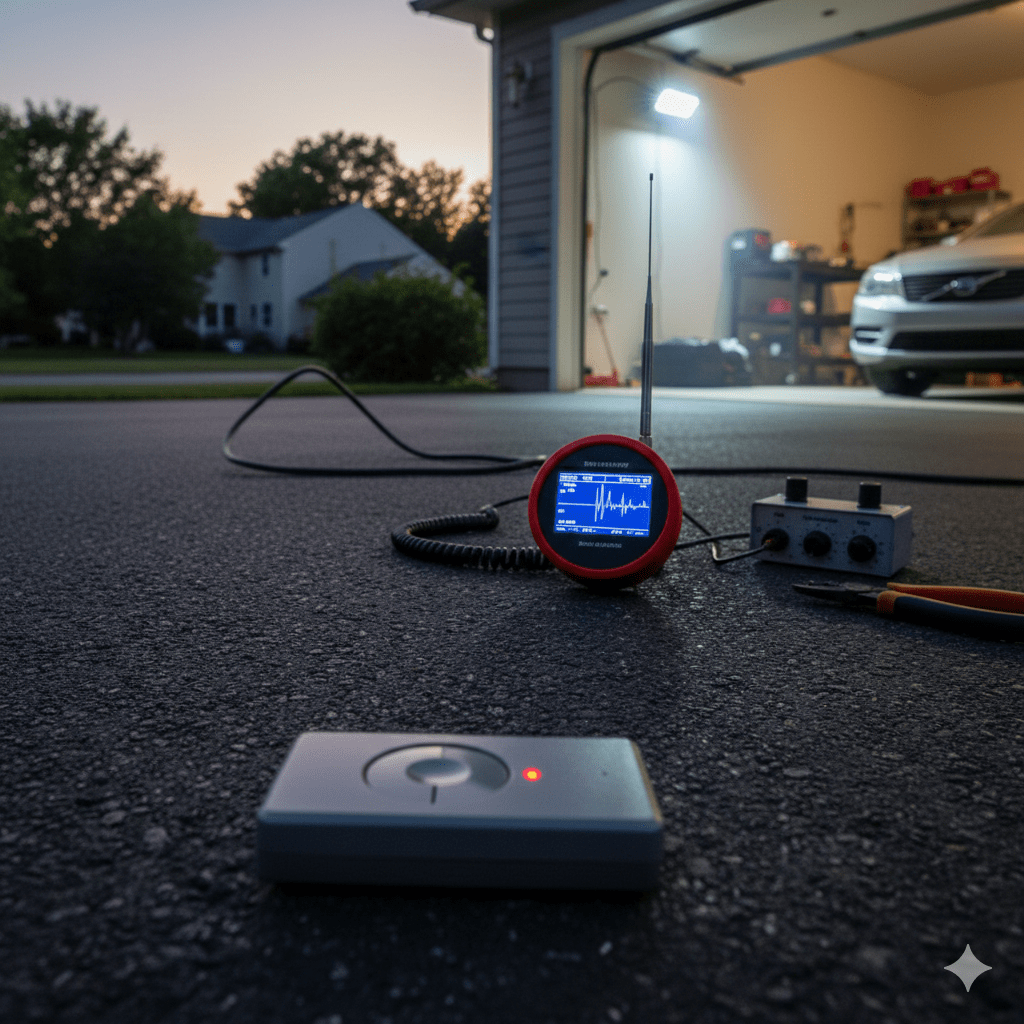
Use a battery‑powered portable AM/FM radio or a cheap software‑defined radio (SDR) to “sniff” wideband noise near the opener. Audible broadband hash or spiking correlating with the failure points to EMI from switching electronics. ARRL and ham‑radio communities use these methods to find sources. arrl.org
Using an SDR or portable radio to sniff noise
A portable radio will let you hear wideband hash; an SDR or spectrum analyzer will show frequency content. If you detect noise that rises when a device is switched on, you have a strong candidate.
Circuit breaker / isolation testing
While listening with a radio, flip breakers one at a time to see if the noise disappears. This identifies which household circuit hosts the offending device. If the noise disappears when a breaker is opened, trace devices on that circuit.
Proven fixes (ranked by cost & invasiveness)
Swap bulbs / replace suspect devices
Buy LEDs or fixtures that meet FCC Part 15 (Class B) or IEC/CISPR limits. Higher‑quality drivers and spread‑spectrum PWM designs reduce emissions. This frequently fixes the problem permanently. webstore.iec.ch
Ferrite chokes, filters, and shielding
Snap‑on ferrite cores on the AC supply to the LED driver and on the opener’s wiring reduce conducted noise into the opener. Field kits and vendor documentation show consistent success. palomar-engineers.com
Antenna relocation and remote upgrades
Ensure the opener’s antenna hangs vertically and is clear of metal/large fixtures. Reroute the antenna away from noisy circuits or cameras. If the remote is old or weak, try a replacement remote or an inline patch antenna.
Frequency change or manufacturer support
Some openers allow reprogramming to different frequencies or use modern radios that are less susceptible. If the opener is old, replacing it with a modern, better‑shielded unit can be the cleanest long‑term fix. arrl.org
Claim → Evidence → Implication example (ferrite chokes)
Claim: Ferrite chokes reduce switching noise that is conducted into the opener.
Evidence: Field kits and manufacturer guidance recommend ferrites on both AC and DC feed lines; technicians report range improvement after installation. palomar-engineers.com
Implication: Ferrites give a low‑cost trial before replacing fixtures. They resolve many cases without rewiring or new openers.
Safety, when to call a pro, and regulatory notes
Call a pro if you hear strong broadband noise you cannot isolate, if the suspected source is a neighbor’s device or utility equipment, or if the problem risks safety (unintended opening) or you are uncomfortable opening devices. ARRL and local amateur RFI teams can help locate external sources; the FCC handles harmful interference complaints when commercial systems are involved. arrl.org
Quick checklist and recommended parts
- High‑quality LED bulb labeled FCC Part 15 / IEC EMC compliant
- Snap‑on ferrite beads (1–250 MHz range)
- Short patch antenna or replacement remote (if remote is weak)
- Portable SDR or hand‑held radio for sniffing (optional)
- Electrician contact (for rewiring / shielding)
Updated, sources, and where to learn more
Updated: February 11, 2026. Primary sources and further reading: ARRL — Radio Frequency Interference (RFI), ARRL — Part 15 devices, Palomar Engineers — Garage Door Opener RFI Kit, IEC — EMC standards, Analog Devices — spread‑spectrum PWM, GarageDoorPedia — LED interference.