
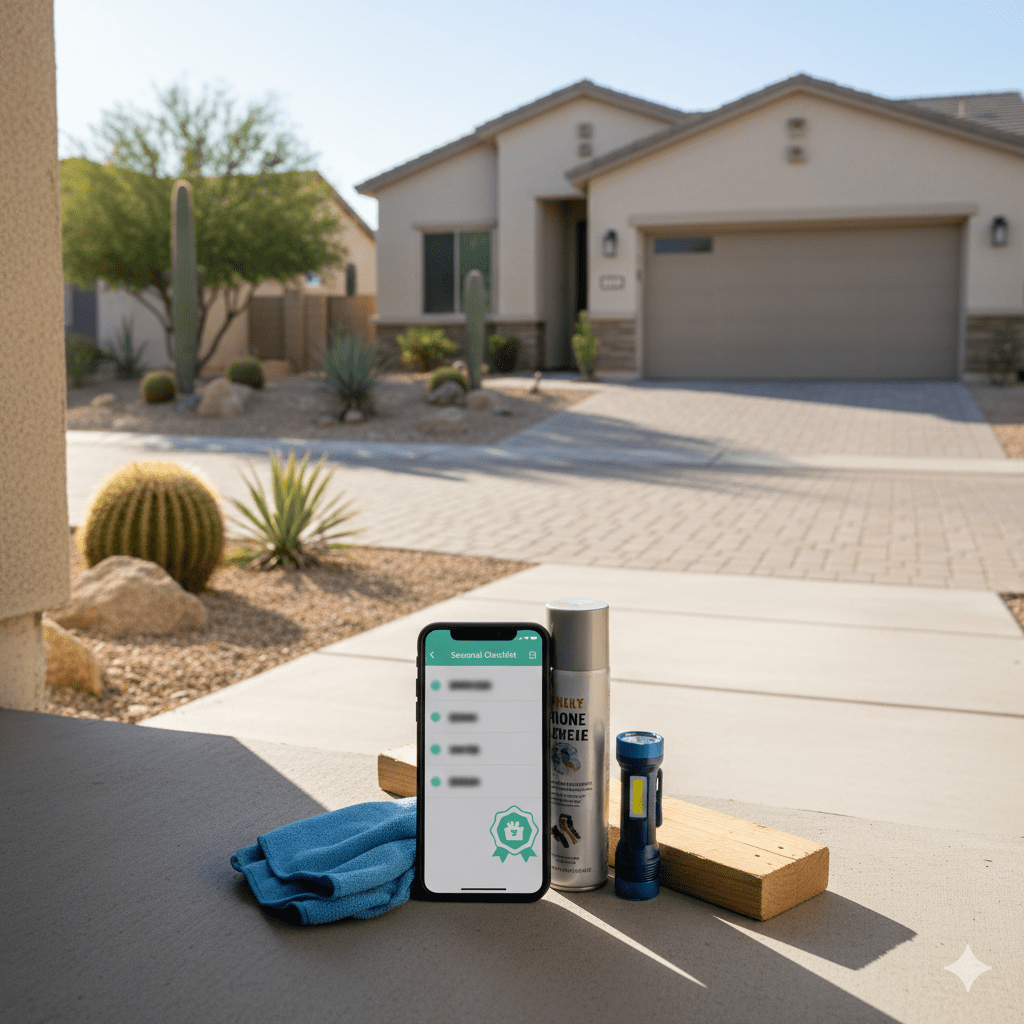
Las Vegas Garage Door Maintenance Challenge (Interactive Checklist) — A Step‑by‑Step Seasonal Guide
Yes — you can turn routine garage‑door maintenance into a Las Vegas–specific, seasonally timed challenge that teaches homeowners how to prevent heat and wind damage, rewards completion with a tune‑up discount, and funnels repair leads back to Desert Door Network. Use a four‑season checklist, a simple scoring system, and mandatory safety warnings for springs and cables. weather.gov
What is the Las Vegas Garage Door Maintenance Challenge?
– Claim: A gamified checklist increases homeowner engagement and reduces emergency repairs.
– Evidence: Technician checklists and homeowner guides show most failures are preventable with routine checks. servicetitan.com
– Implication: When homeowners complete seasonal tasks and submit proof, Desert Door Network gets warm leads and homeowners get fewer emergencies.
Who benefits
- Homeowners: Fewer sudden failures, quieter doors, longer component life.
- Desert Door Network: Brand recall, booked tune‑ups, fewer surprise service calls.
- Neighborhood safety: Properly functioning doors reduce risk from sudden closures and improve security.
Quick rules and rewards
– Rule: Complete seasonal checklist items, take dated photos for proof, fill a 1‑minute submission form.
– Reward suggestion: $25 off a standard tune‑up or 10% off spring/cable replacement if the homeowner schedules within 30 days of submission. (Adjust based on profit margins.)
– Badge system: Bronze (complete one season), Silver (complete two), Gold (annual completion + referral).
What seasonal tasks should Las Vegas homeowners prioritize?
Use this compact seasonal checklist to protect doors from extreme heat and monsoon winds: inspect seals, lubricate moving parts, test safety systems, and flag any red‑flag conditions for professional follow‑up.
Seasonal Checklist (compact)
Columns: Task | Frequency | Difficulty | Tools | Why (Las Vegas‑specific)
Spring (March–May)
- Inspect weatherstripping for cracks; replace if you see daylight at the bottom. (Annually.) Tools: utility knife, replacement rubber. Why: Day/night swings and dust after winter expose seals. nkgaragedoors.com
- Lubricate rollers, hinges, and torsion spring sparingly with silicone spray. (Every 6 months.) Why: Prevent friction and noise in dry heat. servicetitan.com
- Tighten hardware and brackets. (Semiannually.) Why: Vibration over months loosens fasteners. servicetitan.com
Summer (June–September) — Heat focus
- Inspect door panel seals and paint finish; touch up or clean to prevent heat‑accelerated fading. (Annually.) Why: Las Vegas daytime highs average ~105°F in July per climate normals and doors face thermal stress. climate-charts.com
- Check opener electronics for heat warping; test battery backup if present. (Before peak heat.) Why: Electronics and plastic parts can warp under extreme heat and lose function. precisiondoor.net (tips applicable to openers from LiftMaster and Chamberlain)
- Perform balance test to reduce motor strain: disconnect opener, lift door halfway; it should stay. (Quarterly or when noisy.) Why: Heat‑expanded components change door balance. servicetitan.com
Monsoon window (mid‑June–September)
- Clean and align photo‑eye sensors and clear debris from tracks. (Monthly during monsoon.) Why: Dust and wind gusts reduce sensor accuracy and cause auto‑reverse failures. drought.gov
- Inspect bottom seal and thresholds for wind uplift; install a wind‑rated bottom seal if you have wide single‑panel doors. (Annually or after a wind event.) Why: Strong monsoonal outflows create downbursts and gusts. weather.gov
Fall / Winter (October–February)
- Recheck weatherstripping ahead of cooler nights; inspect for contraction‑caused gaps. (Annually.) Why: Cooler nights and occasional rare cold snaps change seal fit. climate-charts.com
- Test auto‑reverse and safety sensors with a 2×4. (Monthly) Why: Safety systems must be functional year‑round. servicetitan.com
How do you run the interactive checklist and gamified challenge?
Scoring, badges, and submission form
- Build: Embed a simple HTML checklist (checkbox fields) plus image upload and date stamp. Ask for name, address, email, and optional photos.
- Score: Assign points: small tasks = 5 pts, moderate tasks = 10 pts, safety verification (photo of 2×4 auto‑reverse test) = 20 pts.
- Badge: 50 pts = Bronze; 100 pts = Silver; 150+ = Gold.
- Submit: Homeowner hits “Submit,” receives a confirmation with a promo code and scheduling link prefilled.
- Verify & Follow up: Desert Door Network reviews photos; if a red‑flag appears (broken spring, frayed cable), mark as priority lead and call within 24 hours.
Sample email / landing page copy for submissions
“Congrats — you completed the Las Vegas Garage Door Maintenance Challenge! Save $25 on a Desert Door Network tune‑up when you book within 30 days. Use code: DDNCHECK25.”
How do I do each seasonal task step‑by‑step (safety first)?
Tools you’ll need
Silicone spray lubricant, soft cloth, ladder, flashlight, adjustable wrench, 2×4 (for auto‑reverse test), replacement weatherstrip, camera/phone.
Detailed numbered steps for each common task
Example: lubricate rollers & hinges
- Close the door and disconnect the opener (pull emergency release).
- Clean rollers and hinge pivot points with a dry cloth to remove grit.
- Spray a light coat of silicone lubricant on bearings and metal pivot points. Avoid over‑spraying. servicetitan.com
- Reconnect the opener and cycle the door 3 times to work the lubricant in. Listen for smoother operation.
Testing auto‑reverse (safety)
- With the door open, place a 2×4 flat on the floor under the door center.
- Close the door using the wall control. The door should reverse immediately when it hits the 2×4.
- If it does not, stop use and schedule a professional inspection — that’s a failure condition. servicetitan.com
When to call a pro
Broken torsion or extension spring, frayed cables, bent tracks, door that won’t stay open/closed, or opener that fails safety tests. Springs are high‑tension and dangerous; do not attempt DIY replacement. thespruce.com
What are the most common failure points in Las Vegas and why?
Heat-driven expansion and seals
Door panels and seals expand and contract with extreme summer temps, which stresses weatherstripping and changes balance. (Use routine checks before and after summer.) climate-charts.com
Dust, wind, and photo‑eye alignment
Dust reduces sensor performance and can wear bearings faster — monthly sensor clean during monsoon months reduces risk. drought.gov
Springs & cables (safety risk)
Age and thermal cycles shorten service life; replacement costs commonly fall in the $150–$350 range, and incorrect DIY attempts cause injury. thespruce.com
How much will common fixes cost and what discount incentive should Desert Door Network offer?
Ballpark repair / tune‑up prices
- Tune‑up: typical range $75–$150 (market dependent). garagedoor-lv.com
- Torsion spring replacement: commonly $150–$350 (consumer guide). thespruce.com
Sample discount structure for submissions
$25 off tune‑up or 10% off spring/cable work when submitted via checklist within 30 days; add higher discount tiers for verified photos showing full completion.
Where can I find more authoritative guides or book a pro?
National Weather Service Las Vegas (climate normals) and North American Monsoon resources are key for seasonal timing. weather.gov
Use technician checklists (ServiceTitan / Precision Door) for detailed inspection items. servicetitan.com • precisiondoor.net
When should this checklist be updated?
Update triggers for content and seasonal changes
- New climate normals release (every 10 years; last 1991–2020). weather.gov
- Major regional weather events (record heat or significant monsoon seasons). ktnv.com
- Manufacturer or safety standard changes (e.g., new opener firmware or safety regulations). precisiondoor.net
Quotable snippets
- “If your garage door won’t reverse when it meets a 2×4, stop using it and call a pro.” servicetitan.com
- “In Las Vegas, July daytime highs average near 105°F — check seals and opener electronics before the heat peaks.” climate-charts.com
- “Lubricate rollers and hinges every six months with a silicone spray — avoid WD‑40 as a long‑term lubricant.” servicetitan.com
- “Monsoon season (mid‑June to September) brings dust and downbursts; clean photo‑eyes monthly during that window.” drought.gov
- “Torsion springs are high tension — DIY replacement is a serious safety risk; expect a professional replacement to cost roughly $150–$350.” thespruce.com